.png?width=200&height=78&name=LR_Logo_vector_horizontal_color_shadow%20(1).png)

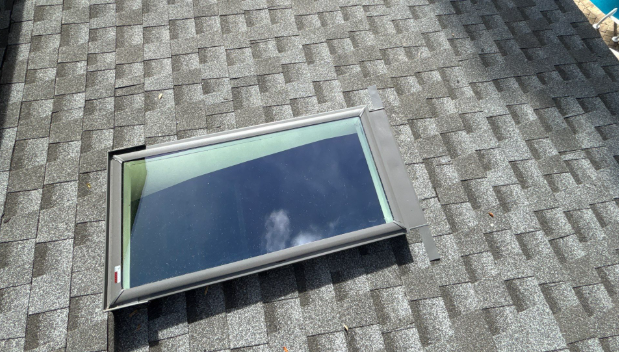
Most skylight leaks come from failed flashing or deteriorated sealant around the frame, not a broken skylight unit. Coastal salt air and hurricane-season storms wear down these materials faster in Myrtle Beach than almost anywhere else, and a proper fix usually costs a few hundred dollars, not a full replacement.
Before budgeting for a new skylight, take a breath. The glass and frame are almost always fine. What's failing is the barrier sealing the joint between the skylight and the roof, and that's a repair, not a replacement.
Here's who's walking you through it: Linta Roofing, at lintaroofing.com, is a third-generation family roofing contractor based in Little River, South Carolina, serving the Grand Strand. They handle residential and commercial roofs across four counties in two states, covering repair, replacement, maintenance, inspection, emergency response and insurance claim work.
In this article:
- What Causes a Skylight to Leak? The Most Common Culprits
- How Myrtle Beach's Climate Makes Skylight Leaks Worse
- Signs Your Skylight Is Leaking (And How to Tell It's Not Condensation)
- DIY Skylight Leak Fixes You Can Try Today
- When to Call a Professional Roofer in Myrtle Beach
- How to Prevent Skylight Leaks: Maintenance Tips for Coastal Homes
- Frequently Asked Questions
What Causes a Skylight to Leak? The Most Common Culprits
The first thing most homeowners get wrong is assuming the skylight unit itself is broken. In the vast majority of cases, the glass and frame are intact. It's usually one of these:
- Failed flashing: The metal barrier sealing the joint between the skylight frame and the surrounding roof lifts, corrodes, or separates from the deck, giving water a direct path inside.
- Deteriorated sealant: The bead backing up the flashing typically starts failing five to ten years after installation, often sooner on sun-baked coastal roofs.
- A misdiagnosed entry point: Water travels along roof decking and framing before it shows up inside, so a stain near the center of a skylight often traces back to a flashing failure at the uphill edge, not the spot directly above it.
That last point is why patching the wrong spot is the most common and most expensive mistake homeowners make.
How Myrtle Beach's Climate Makes Skylight Leaks Worse
Salt air is corrosive in a way that's easy to underestimate. A few local factors push skylight leaks along faster here than almost anywhere else:
- Salt corrosion. Flashing on coastal roofs can show rust and pitting within three to five years, a timeline that would take a decade or more inland.
- Storm-driven rain. Myrtle Beach averages over 55 inches of rain per year, and tropical storms push water horizontally across rooflines in ways standard installation doesn't fully account for.
- UV breakdown. Manufacturer sealant ratings are tested under average conditions, not sustained South Carolina summer heat, so real-world breakdown happens faster than the label suggests.
For homeowners with 10- to 15-year-old roofs in the Grand Strand area, the flashing around skylights and other penetrations is often the first component to fail, even when the field shingles still look fine from the ground. Rinsing salt residue off the skylight frame and surrounding roof a few times a year helps, since buildup attacks flashing fasteners long before any rust is visible.
Signs Your Skylight Is Leaking (And How to Tell It's Not Condensation)
A true leak shows up during or after rain: water tracking along the frame, drips from the ceiling, or wet insulation in the attic below the unit. The source is external, and it's almost always the flashing or seal.
Condensation is different. It forms on the interior glass when warm, humid indoor air meets the cooler frame, and in Myrtle Beach, where indoor humidity routinely climbs above 70% from late spring through early fall, this happens often. It isn't a structural problem on its own, but repeated drips onto drywall cause the same staining and mold growth as a real leak.
Here's how to tell them apart:
- Timing after a dry night: moisture on a dry day following a humid night points to condensation.
- Timing during rain: moisture during or within a few hours of rainfall points to an actual leak.
- Pattern on the glass: condensation spreads evenly across the surface.
- Pattern at the frame: leak water tracks along the frame edge or pools in a corner.
DIY Skylight Leak Fixes You Can Try Today
If the leak is coming from failed sealant and you're comfortable on a roof, this is a manageable DIY repair:
- Strip the old caulk completely. This is the step most people skip. Sealing over deteriorated caulk traps moisture underneath and guarantees the new bead fails within a season.
- Clean and dry the surface fully before applying anything new.
- Apply a silicone-based sealant rated for exterior roofing use, only after the surface temperature drops below 90°F. Sealant applied to an overheated roof in a Myrtle Beach summer won't cure properly and will peel within months.
Flashing repairs are a different category. They require lifting shingles, setting metal correctly against the roof deck, and re-integrating it with the drainage layer underneath. On older coastal installations, the original flashing was often never sealed properly at the corners, so a surface reseal just delays the problem by one more storm season. This is also where roofers cut corners, replacing visible sealant without checking the flashing underneath.
How to Prevent Skylight Leaks: Maintenance Tips for Coastal Homes
Inspect the sealant around the frame every fall before storm season and again in spring. Lifting, cracking, or color change in the caulk are early signs it's failing, and catching them before a storm costs far less than repairing after one.
If your skylight is more than 15 years old and the flashing has never been replaced, that's the first thing to ask a roofer about. Original flashing on older coastal homes is often well past its useful life even when the surface looks intact from the ground. Keep gutters clear too, since backed-up water along the roofline can wick under flashing and around skylight curbs even when the skylight itself is in good shape.
Most skylight leak repairs in the Myrtle Beach area fall into a few ranges:
- Sealant repair: $150–$300
- Flashing replacement: $300–$600
- Full skylight replacement: $800–$1,500 installed
Full replacement only makes sense when the unit itself is cracked, badly corroded, or was installed incorrectly from the start. We assess the actual condition before recommending either path, because replacing a skylight that only needed a $200 reseal is the kind of upsell that gives this industry a bad reputation. For more on the diagnosis side, see our guide on whether skylights always leak in Myrtle Beach.
When to Call a Professional Roofer in Myrtle Beach
If a sealant fix doesn't stop the leak, you can't identify a single clear entry point, or the skylight is more than 15 years old, it's time for a roof repair assessment, one that actually inspects the flashing rather than quoting off a phone description.
This matters most after a storm: a small flashing breach left open for a week in post-storm humidity can saturate the decking, wick into wall cavities, and turn a $300 reseal into a $2,000 decking repair plus mold remediation, and contractors book up fast after major weather events, so it pays to call early rather than assume the leak is minor.
A leaking skylight almost never means the skylight needs to go. It means the materials sealing it to the roof have done their job for years and finally need attention, and in most cases, a targeted repair is all it takes.
Want to learn more on your own? Linta Roofing runs a roofing learning center and a YouTube channel where the owner answers homeowner questions to provide first-person education to everyone.
Schedule an inspection to know exactly what you're dealing with and what it'll actually cost to fix.
Frequently Asked Questions
Why is my skylight leaking during heavy rain?
Almost always failed flashing at the frame edges. Even a small gap turns into a real leak the moment a Myrtle Beach storm hits.
What are the most common causes of skylight leaks?
Deteriorated flashing, dried-out sealant, an aging frame, or condensation mistaken for a leak. Salt air speeds up all of these on the coast.
Can I fix a leaking skylight myself or should I call a professional?
Resealing is a reasonable DIY fix for surface-level sealant issues. Flashing problems or an unclear entry point call for a professional.
How much does it cost to repair a leaking skylight?
Sealant repairs run $150–$300, flashing replacement $300–$600, and full replacement $800–$1,500 installed.
How do I prevent skylight leaks in humid coastal climates like Myrtle Beach?
Inspect the flashing and sealant annually before hurricane season, use UV-resistant sealant, and keep the attic well ventilated to cut down on condensation.
Jeffrey Linta is the CEO and owner of Linta Roofing, a third-generation roofer who took ownership of the family business in 2023. He began his career in high school with boots on the ground, working in the field and learning the roofing trade from his father before joining the company full time after college graduation. His professional credentials include GAF Master Elite Contractor, IKO ROOFPRO Craftsman Premier Contractor, GAF GoldElite Commercial Contractor, GAF presidents club award winner and SC Safe Home Certified Contractor. Under his leadership, Linta Roofing has earned recognition such as the Sun News' Best of the Beach in 2024 and 2025, an A+ rating from the Better Business Bureau, and hundreds of 5-star customer reviews year after year. Most recently, Linta Roofing was honored with the Best Roofing Company of the Year 2025 award from Roofing Insights. Born and raised on the Grand Strand, Jeffrey is passionate about educating homeowners so they can make confident, informed decisions about their roofing investments. Outside of work, he enjoys fishing and spending time with his wife, Erica, son, Grady, and golden retriever, Dixie. To learn more about Jeffrey Linta's story, check out his interview with Roofing Insights, a nationally recognized roofing education platform: Jeffrey Linta: Building a Roofing Company Without Fear of Competitors.
