.png?width=200&height=78&name=LR_Logo_vector_horizontal_color_shadow%20(1).png)

Discontinued or Mismatched Roof Shingles: Will Insurance Replace Your Whole Roof?
August 21st, 2026
5 min read
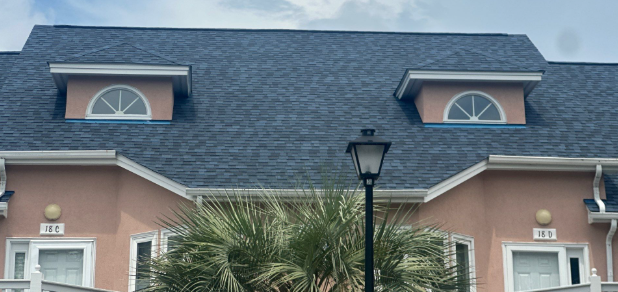
Whether insurance replaces your whole roof over discontinued or mismatched shingles depends on your policy's matching language and your state's laws. Some states legally require a full replacement when a matching shingle can't be sourced; where no such law exists, your declarations page and documentation determine the outcome.
You filed a storm claim expecting a full roof replacement. The adjuster came out, approved a patch, and now half your roof is a noticeably different shade. Why won't insurance replace the whole thing? The answer depends on your policy language, your state's laws, and how well the damage was documented in the first place.
What Are Discontinued Roof Shingles and Why Does It Matter for Insurance?
Shingle manufacturers retire product lines all the time. Colors get phased out, profiles change, entire brands get absorbed or discontinued. If your roof was installed 10 or 15 years ago, which describes most of the homes we see in the Myrtle Beach area, there's a real chance the exact shingle no longer exists.
This matters because most policies are written to restore your home to its pre-loss condition. If a storm damages 20 shingles and those shingles no longer exist, a partial repair can't actually do that. That's the argument homeowners need to make, and it's a strong one.
The problem is that insurers often interpret "pre-loss condition" as functionally equivalent, not visually identical. They'll find the closest available shingle, patch the damage, issue payment, and consider the claim closed. Whether that's acceptable depends on your state's laws and your policy language, not the adjuster's verbal explanation at the end of the inspection.
How Insurance Companies Handle Discontinued or Mismatched Shingle Claims
The standard insurer approach is to approve repairs for only the damaged sections, source the closest available shingle, and issue payment accordingly. If your shingles are still in production and the color match is tight, this is usually fine. If they're discontinued, you end up with a patchwork roof that looks noticeably different from the street, especially once new shingles start weathering differently from the originals within a year or two.
Insurers will sometimes argue that cosmetic mismatch doesn't affect the roof's function, so it doesn't trigger full replacement. That argument holds up in some states and collapses completely in others. Document every conversation, get the denial in writing, and hold onto the adjuster's report. You'll need it if you push back.
State-by-State Matching Laws: Does Your State Require a Full Roof Replacement?
Some states have codified matching requirements into insurance law; others have no such protections.
|
State |
Matching Requirement |
|
Florida |
Yes, insurers must match in color and appearance |
|
Minnesota |
Yes, strong matching statute protects homeowners |
|
Wisconsin |
Yes, matching required for uniformity |
|
Texas |
Partial, depends on policy language and adjuster |
|
California |
No specific statute; policy language controls |
|
Ohio |
No specific statute; adjuster discretion applies |
|
Georgia |
No specific statute; outcome varies by insurer |
|
Illinois |
No specific statute; policy language controls |
If your state has a matching law, cite it explicitly in your claim. Adjusters don't always volunteer this information.
South Carolina, where most of our customers are based, doesn't have a standalone shingle matching statute, which means policy language controls. That's not a dead end. Pull your declarations page and look for words like "matching," "uniformity," or "like kind and quality." Any of those phrases gives you a basis to push back on a mismatched repair, even without a state law behind you.
Linta Roofing inspects storm damage to the same engineering standard insurers use to decide whether a claim is covered. Their project managers are HAAG trained, the damage assessment is free, and they meet your adjuster at the house so the approval reflects current building code instead of leaving you to pay the difference.
Repair vs. Full Replacement: How to Know Which One You're Entitled To
Full replacement is your strongest argument when the damaged shingles are discontinued, when the repair area is large and visible from the street, or when your policy includes matching language. The bigger and more visible the mismatch, the harder it is for an insurer to justify a patch.
Repair is harder to dispute when the damage is minor, the shingles are still in production, and the color match is close, particularly on a rear slope that isn't visible from the ground.
Before you accept any repair proposal, ask the insurer in writing to confirm that the replacement shingle is an exact match. If they can't confirm it, that admission becomes part of your claim record.
What Is the "Line of Sight" Rule and How Can It Work in Your Favor?
The line of sight rule defines what counts as a required match. If the repaired section is visible from the same vantage point as the rest of the roof, it must match. If it's hidden behind a parapet wall or set entirely below a ridgeline, an insurer might argue matching isn't required.
On most standard residential roofs, this rule skews toward homeowners. Front slopes, side slopes, and often rear slopes are all visible from the ground or a neighboring property, and the weathering differential between new and old shingles becomes most obvious over a few seasons of UV exposure and coastal humidity.
Stand at the street and look at your roof. If you can clearly see the repaired section alongside the original, photograph it before any additional work is scheduled. A contractor who photographs every visible slope before and after a repair proposal, and puts that documentation in writing to the insurer, gives you something concrete to reference in a dispute.
Steps to File an Insurance Claim for Discontinued or Mismatched Shingles
- Document the damage thoroughly with photos before anything is touched.
- Contact your insurer to open a claim, and specifically note that the shingles may be discontinued.
- Ask the adjuster directly whether matching is a consideration under your policy.
- Get their shingle recommendation in writing before any work begins.
- Understand how ACV and RCV payouts affect what you're owed before you agree to anything.
- If a proposed repair uses a shingle you can't verify as a match, submit a written objection referencing your policy's matching or uniformity language before anyone gets on the roof.
The pattern that leads to the worst outcomes is almost always the same: a homeowner accepts a verbal explanation from the adjuster, work gets approved and scheduled, and by the time the patched area weathers to a different shade, there's no written record to support a reversal.
What to Do If Your Insurer Denies a Full Roof Replacement
A denial isn't final.
- Request a formal reconsideration in writing, citing the specific policy language you believe supports full replacement.
- Attach your street-view photos, the adjuster's written shingle recommendation, and any documentation of the product being discontinued.
- If that doesn't move things forward, hire a public adjuster or work with a roofer who already knows how to make that case. For a legitimate mismatch claim where your policy includes matching language, a public adjuster often pays for itself.
- File a formal complaint with your state's department of insurance if the insurer still won't budge. Insurers take those seriously.
We can help you navigate that process, including any code upgrade requirements that may apply to your replacement. Our approach to storm damage claims is to assess what the roof actually needs, document it thoroughly, and give you the evidence you need to pursue the right outcome, especially when an insurer's first offer falls short.
Linta Roofing has helped thousands of homeowners manage the roof insurance claim process over the last 40 years and more.
Not sure whether your claim qualifies for a full replacement? Take our Insurance Claim Qualification Quiz or contact us to have one of our project managers review your policy and documentation.
Frequently Asked Questions
Will insurance pay for a full roof replacement if my shingles are discontinued?
It depends on your policy language and state law. Some policies and state regulations require full replacement when a matching shingle can't be sourced. Without that protection in writing, most adjusters will default to a partial repair.
What happens when replacement shingles don't match my existing roof?
You end up with a visibly mismatched roof, which can hurt curb appeal and resale value. Whether insurance owes you a full replacement depends on whether your policy has a matching clause and your state enforces one.
Does homeowners insurance cover mismatched roof shingles?
Not automatically. Standard policies cover the damaged portion, not the aesthetic outcome. Some include matching provisions requiring a uniform appearance, but many don't, so check your policy before filing.
Are there state laws that require insurance companies to match roof shingles?
Yes, several states have matching laws requiring reasonably uniform repairs. If your roof no longer matches after repairs, you may be owed a full replacement. Requirements vary by state.
How do insurance adjusters determine whether replacement shingles are a reasonable match?
They look at color, style, and manufacturer compatibility, but "reasonable match" is subjective and often interpreted in the insurer's favor. Documentation, photos, and discontinuation notices are what move the needle.
Jeffrey Linta is the CEO and owner of Linta Roofing, a third-generation roofer who took ownership of the family business in 2023. He began his career in high school with boots on the ground, working in the field and learning the roofing trade from his father before joining the company full time after college graduation. His professional credentials include GAF Master Elite Contractor, IKO ROOFPRO Craftsman Premier Contractor, GAF GoldElite Commercial Contractor, GAF presidents club award winner and SC Safe Home Certified Contractor. Under his leadership, Linta Roofing has earned recognition such as the Sun News' Best of the Beach in 2024 and 2025, an A+ rating from the Better Business Bureau, and hundreds of 5-star customer reviews year after year. Most recently, Linta Roofing was honored with the Best Roofing Company of the Year 2025 award from Roofing Insights. Born and raised on the Grand Strand, Jeffrey is passionate about educating homeowners so they can make confident, informed decisions about their roofing investments. Outside of work, he enjoys fishing and spending time with his wife, Erica, son, Grady, and golden retriever, Dixie. To learn more about Jeffrey Linta's story, check out his interview with Roofing Insights, a nationally recognized roofing education platform: Jeffrey Linta: Building a Roofing Company Without Fear of Competitors.
