

Questions to Ask a Roofer Before an Inspection: A Homeowner Checklist
November 16th, 2026
6 min read
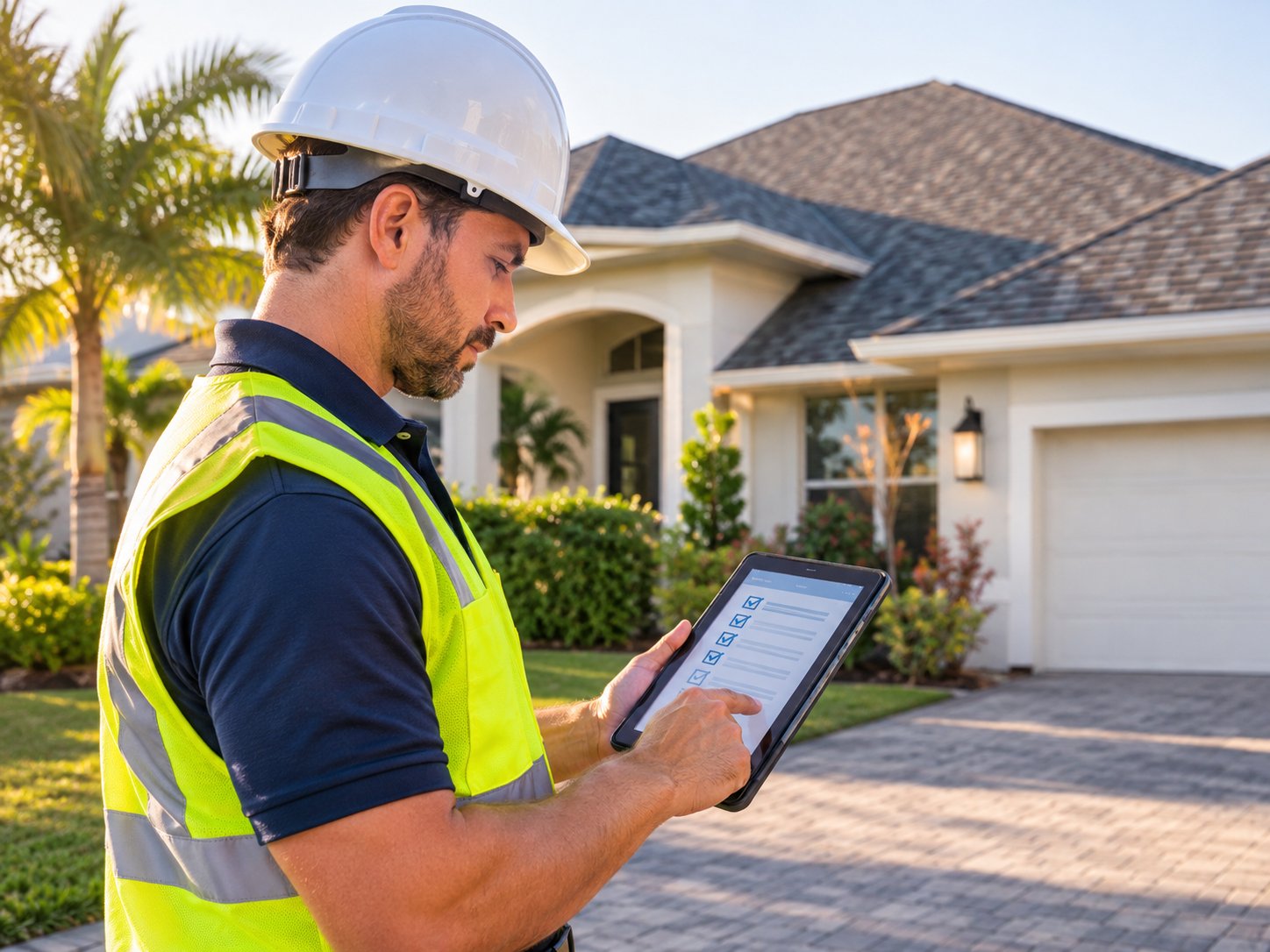
Questions to ask a roofer start before anyone climbs a ladder, because the inspection is the hour you get to judge them face to face.
From our experience at Linta Roofing, the answers that hold up come with photos, a written report, and a price that matches what was agreed. Ask the right questions on the phone, on the roof, and over the estimate. Check every answer against a record you can open yourself.
Table of Contents
- What should you ask a roofer before the inspection?
- What should you ask during the roof inspection?
- What should you ask about the estimate, warranty, and crew?
- How do you check a roofer's answers?
- What are the red flags when hiring a roofer?
- Frequently asked questions
What should you ask a roofer before the inspection?
Ask four things on the booking call: the inspection fee, the license number, whether you get a photo report, and whether you need to be home. Those four questions tell you more about a roofer than any review site will.
1. What does the inspection cost? Our inspection is complimentary for a replacement, $125 for a repair assessment, and $235 for a forensic report used in a sale or insurance dispute. See how much a roof inspection costs for a full breakdown. Any roofer who can't quote a fee upfront is worth skipping.
2. What is your South Carolina license number? Residential contracting in South Carolina requires a current license or registration through the SC LLR. Ask for the number before the visit, then look it up yourself. We cover exactly how in our guide to verifying a roofer's license and insurance in South Carolina.
3. Will I get a written report with photos? A written report with photos documents existing conditions for insurance claims and resale. If the roofer says they'll just call you with the findings, that's not enough. You need something you can send to an insurer or a buyer.
4. Do I need to be home? You don't have to be, but we recommend it. Being present when the inspector walks through the findings means you hear it firsthand, not in a summary. See what to do before a roof inspection for how to get the most out of the visit.
What should you ask during the roof inspection?
Ask what they found, whether it calls for a repair or a replacement, and how many years the roof has left. Those three questions should drive every inspection conversation.
1. Should this roof be repaired or replaced? This is the question the inspection exists to answer. A roofer who recommends replacement on every job is not giving you an honest assessment. One who patches obvious structural problems is deferring a cost you'll pay later. Our HAAG-trained inspectors are there to tell you which one applies to your roof, not to sell you a job. Linta Roofing inspects storm damage to the same engineering standard insurers use to decide whether a claim is covered. Most of our inspections take 60 to 90 minutes, including the report walkthrough. Book a roof inspection if you want that answer in writing.
2. How many years does this roof have left? Our inspection verifies remaining lifespan based on shingle condition, decking integrity, and ventilation health, not just surface appearance. A roofer who gives you a vague answer like "it's getting up there" is not giving you usable information.
3. Are there ventilation, flashing, or decking problems I can't see from the ground? One of our past clients put it well: "In addition to looking at the obvious damage we had, he inspected our entire roof and told me what things to look for in the future." That's what a thorough inspection looks like. Flashing and decking problems are hard to see from street level, and failed flashing is one of the most common causes of roof leaks.
4. Can this roof be built to a stronger wind standard? Often yes. SC Safe Home pays for wind-resistant roof upgrades, such as stronger deck attachment, a secondary water barrier, and a high wind-rated shingle, with grants of up to $7,500 for qualifying coastal homeowners. The state opens applications in set windows, so check the SC Safe Home site for the current one. We are an SC Safe Home certified contractor. Ask any roofer you're considering whether they are too.
What should you ask about the estimate, warranty, and crew?
Before you sign anything, get the shingle brand, the workmanship warranty term, and the name of whoever does the work, all in writing. A verbal commitment on any of those is not a commitment.
1. Can I have the shingle brand, product line, and color in writing? Yes, and ask for it as a line item, not a vague description like "architectural shingles." Our shingle packages run about $13,545 to $25,875 for a 3,000 square foot roof across Essential ($13,545 to $22,575, 12-year workmanship warranty) and Signature ($15,525 to $25,875, 25-year). Premier runs $25,875 to $43,125 with a 25-year workmanship warranty. See What to know before choosing a roof estimate for what else to look for.
2. How long is your workmanship warranty, and what does it cover? Our take: the manufacturer warranty covers materials; the workmanship warranty covers installation errors, and those are two entirely different things. If a shingle fails because it was nailed incorrectly, the manufacturer won't pay. That's on the contractor. If a Linta Roofing roof ever leaks, you call Linta, not the shingle manufacturer. Get the workmanship warranty term and what it excludes in writing before the job starts. Our guide to what a workmanship warranty covers explains the difference in full.
3. Will your own crew do the work, or subcontractors? A company that uses commission-only 1099 sales reps to write the job and hands it off to people you've never met is a different operation than one that tells you up front who will be on your roof. We explain the problem in why 1099 sales reps give roofers a bad name. Our past clients notice the difference: "They did exactly what was agreed upon in the contract and more."
4. How will you protect my yard and clean up? Ask specifically about shingle disposal, nail collection, and landscaping protection. These are not minor details on a full replacement. Linta Roofing assigns a dedicated quality control manager to each installation and sends the homeowner live photos and videos as the work happens.
How do you check a roofer's answers?
Check each answer against a record you can open: the state license lookup, the insurer, the shingle maker's directory, and reviews in volume. A roofer who objects to that is a roofer to skip.
1. Look up the license number on the SC LLR licensing site. The search is public and takes under a minute.
2. Ask for the certificate of insurance, then call the insurer directly to confirm the policy is active. Certificates can be outdated.
3. Find the roofer in the shingle manufacturer's own contractor directory. GAF's directory, for example, lists Linta Roofing as a GAF Master Elite contractor with a 5.0 rating.
4. Read reviews in volume, not just the highlighted ones, and ask for references from jobs similar to yours in age, size, and scope.
For more on what certification actually means in practice, see why hire a certified roofing company.
What are the red flags when hiring a roofer?
A knock on the door after a storm, pressure to sign that day, and a request for money or your insurance claim up front are the clearest signs to walk away.
Storm-chasing crews follow severe weather into coastal markets, offer a "free inspection," and push you to sign before you've had time to compare a single other quote. The South Carolina Attorney General's office warns that scammers use "free inspections" after storms to pressure homeowners into unnecessary work, and advises homeowners not to sign documents that assign insurance benefits to a contractor.
An Assignment of Benefits (AOB) is worth understanding before anyone asks you to sign one. It transfers your right to your insurance claim directly to the contractor, which typically lets the contractor deal with your insurer on your behalf. That arrangement can leave you with less say in how your claim is handled. We are not offering legal advice here, only flagging the term so you recognize it when you see it.
Our salespeople are W-2 employees, not 1099 commission reps. For a full breakdown of what storm scams look like and how to spot them, see how to spot a roofing scam after a storm.
Frequently asked questions
How are roof inspections done?
Our HAAG-trained inspectors get on the roof and check the ventilation, flashing, and decking that are invisible from the ground, then walk through the written photo report with you at the end.
Most inspections take 60 to 90 minutes including that walkthrough. See our roof inspection services page for what the visit covers.
How often should a roof be inspected?
We recommend a roof inspection at least once a year, and GAF suggests homeowners spot-check their roof themselves in spring and fall. Book another after any severe storm or hurricane. The Grand Strand's coastal wind, humidity, and hurricane season are hard on roofing systems, and problems found early cost less to fix.
Should I get more than one roofing quote?
Yes. Several of our past clients compared two to four quotes before they hired us. Reading estimates side by side against a detailed scope of work shows quickly where bids differ and why. What to know before choosing a roof estimate walks through what to look for in each one.
Why do I keep getting calls about roof inspections?
The unsolicited calls and door knocks are usually tied to storm activity in your area. The pitch is a "free inspection" that leads quickly to a replacement quote and pressure to sign. How to spot a roofing scam after a storm covers the specific tactics and what to say when it happens.
What type of inspection should a roofer do?
Ask upfront whether the roofer will do a visual walkthrough or a full hands-on inspection that includes getting on the roof. A drive-by or ground-level look misses a lot: loose flashing, soft decking, and granule loss rarely show up from the street. Before booking, confirm exactly what the inspection covers and how the roofer will access and assess the roof surface.
Should a roofer inspect the attic as well as the roof?
A complete inspection should cover both the outside of the roof and the attic interior. Staining, moisture damage, and inadequate insulation often show up inside long before they're visible on the shingles above. If a roofer only checks the exterior, you may be missing half the picture.
Going into an inspection with these questions prepared puts you on even footing with a contractor who does this every day, and if you want more guidance on vetting your options, our guide on how to choose the right roofing contractor covers what to look for beyond the inspection itself. If you're ready to schedule a visit, book a roof inspection with our team and we'll walk you through the written report.
Jeffrey Linta is the CEO and owner of Linta Roofing, a third-generation roofer who took ownership of the family business in 2023. He began his career in high school with boots on the ground, working in the field and learning the roofing trade from his father before joining the company full time after college graduation. His professional credentials include GAF Master Elite Contractor, IKO ROOFPRO Craftsman Premier Contractor, GAF GoldElite Commercial Contractor, GAF presidents club award winner and SC Safe Home Certified Contractor. Under his leadership, Linta Roofing has earned recognition such as the Sun News' Best of the Beach in 2024 and 2025, an A+ rating from the Better Business Bureau, and hundreds of 5-star customer reviews year after year. Most recently, Linta Roofing was honored with the Best Roofing Company of the Year 2025 award from Roofing Insights. Born and raised on the Grand Strand, Jeffrey is passionate about educating homeowners so they can make confident, informed decisions about their roofing investments. Outside of work, he enjoys fishing and spending time with his wife, Erica, son, Grady, and golden retriever, Dixie. To learn more about Jeffrey Linta's story, check out his interview with Roofing Insights, a nationally recognized roofing education platform: Jeffrey Linta: Building a Roofing Company Without Fear of Competitors.
