.png?width=200&height=78&name=LR_Logo_vector_horizontal_color_shadow%20(1).png)

A commercial roof replacement is one of the biggest line items a property owner or facility manager will ever approve. And when you're looking at numbers in the tens of thousands, knowing what drives the cost and how you can finance it changes everything about how you approach the decision.
Table of Content
- How Much Does a Commercial Roof Replacement Cost Per Square Foot?
- How Do TPO, EPDM, and Metal Compare for Commercial Buildings?
- What Financing Options Are Available for a Commercial Roof Replacement?
- What Should You Watch Out For When Financing a Commercial Roof?
- Ready to Get a Commercial Roofing Estimate?
- Frequently Asked Questions
How Much Does a Commercial Roof Replacement Cost Per Square Foot?
Commercial roofing costs vary widely based on the system you choose, the size and complexity of your roof, and current material prices. In 2026, here's what you can expect to pay per square foot for the most common commercial roof types:
|
Roof Type |
Cost Per Sq. Ft. |
Cost Per Square (100 sq. ft.) |
Typical Project Range |
|
TPO (Single-Ply Membrane) |
$5 – $10 |
$500 – $1,000 |
$15,000 – $60,000+ |
|
EPDM (Rubber Membrane) |
$4 – $9 |
$400 – $900 |
$10,000 – $55,000+ |
|
Standing Seam Metal |
$10 – $20 |
$1,000 – $2,000 |
$25,000 – $100,000+ |
|
Modified Bitumen |
$4 – $8 |
$400 – $800 |
$10,000 – $45,000+ |
|
Built-Up Roofing (BUR) |
$5 – $10 |
$500 – $1,000 |
$12,000 – $55,000+ |
These ranges reflect installed costs, materials plus labor. They do not include tear-off of an existing roof system, which typically adds $1 to $3 per square foot, or structural repairs if the deck is damaged.
How Do TPO, EPDM, and Metal Compare for Commercial Buildings?
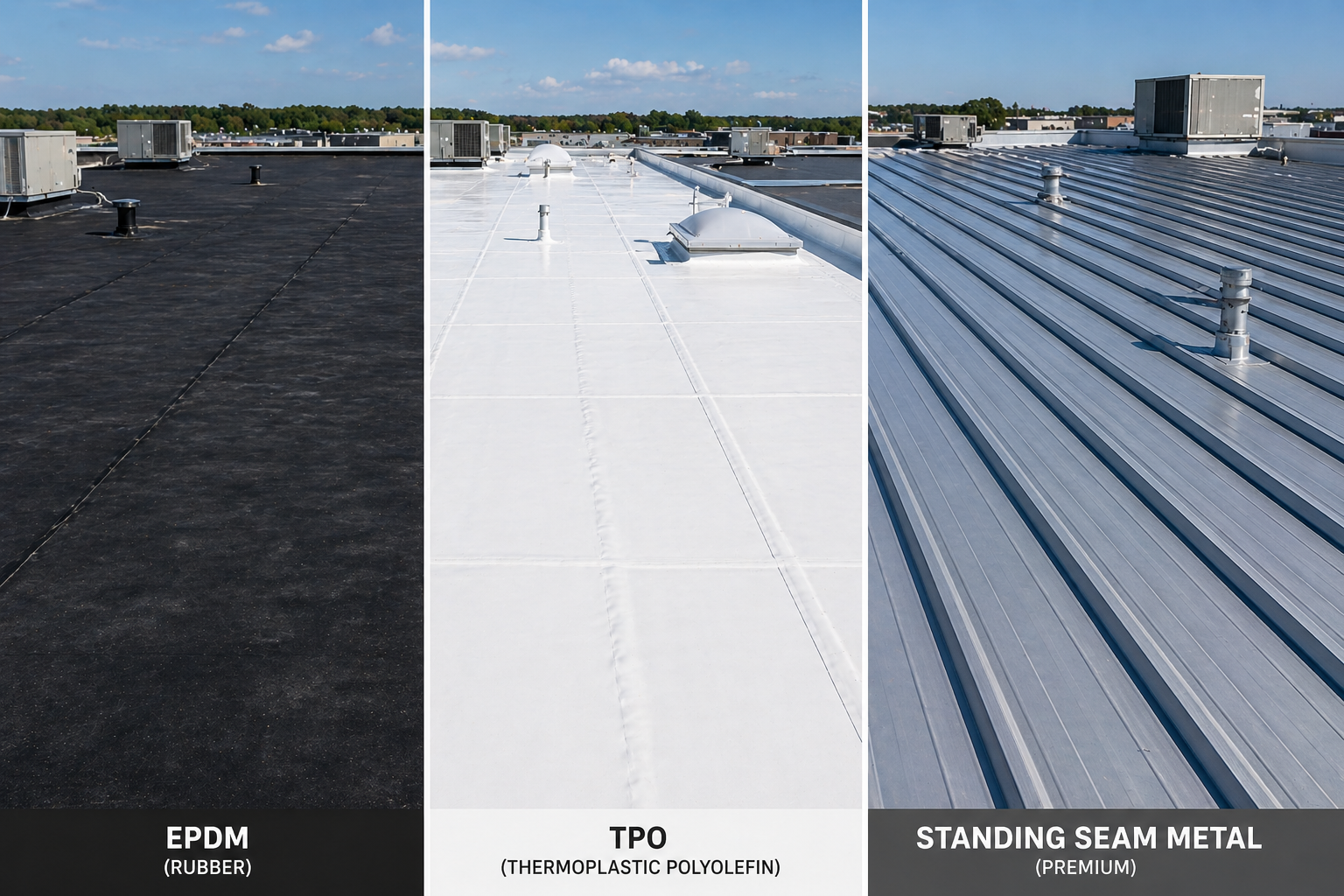 If you're deciding between systems, here's a practical breakdown of the three most common choices for commercial properties in the coastal Carolinas:
TPO (Thermoplastic Polyolefin)
TPO is the most widely installed commercial flat roofing system today. For a standard low-slope commercial roof, expect to pay $5 to $10 per square foot installed. Most TPO systems carry a 15- to 25-year manufacturer warranty.
EPDM (Ethylene Propylene Diene Monomer)
EPDM, often called rubber roofing, has been used on commercial buildings for decades. It's flexible, durable, and handles temperature swings well. It costs slightly less than TPO at $4 to $9 per square foot installed, but it's typically black, which absorbs heat rather than reflecting it.
Standing Seam Metal
Standing seam metal is the premium commercial option. At $10 to $20 per square foot installed, it costs significantly more upfront, but it lasts two to three times longer than membrane systems and holds up exceptionally well against wind-driven rain and coastal conditions.
What Financing Options Are Available for a Commercial Roof Replacement?
Most commercial property owners don't write a check for $50,000 to $200,000 the same week they get a roofing estimate. The good news is that several financing pathways are available, and some are better suited to commercial projects than others.
Commercial Business Loans
A standard commercial loan or business line of credit from your bank or credit union is often the most straightforward route for established businesses.
If you have a relationship with a lender, you may be able to access favorable terms based on your business history and assets. These loans typically offer fixed or variable rates and repayment terms of three to ten years, depending on the loan size and lender.
SBA Loans
Small Business Administration (SBA) loans can be an excellent tool for commercial roof financing. The SBA 7(a) loan program allows businesses to borrow up to $5 million for capital improvements, including roof replacements, at competitive interest rates with longer repayment terms than most conventional loans.
The SBA 504 program is another option specifically designed for major fixed assets, although SBA loans require more paperwork and longer approval timelines.
Equipment and Asset-Based Financing
Roofing systems qualify as a capital improvement, and some lenders offer financing specifically structured around commercial building improvements. In these arrangements, the roof itself, or the building's equity, serves as collateral.
Terms vary by lender, but this can be an efficient route if your building has significant equity and you want to preserve your working capital.
Contractor Payment Plans
Some roofing contractors offer in-house payment plans or partner with third-party financing companies to provide monthly payment options at the point of sale. Terms, interest rates, and eligibility requirements vary significantly by contractor and financing partner.
Linta’s own program follows that same third-party model. Linta Roofing offers third-party roof financing that does not run a hard credit inquiry. Linta also states that there are five main ways to pay for a roof and that it offers all five.
Insurance Financing (for Storm-Damaged Roofs)
If your roof was damaged by a storm, your commercial property insurance policy may cover part or all of the replacement cost. The key variables are your policy's coverage terms, your deductible, and whether the damage is documented and attributed to a covered event.
PACE Financing (Property Assessed Clean Energy)
If your commercial roof replacement includes energy-efficient upgrades you may qualify for PACE financing. PACE programs allow property owners to finance improvements through an assessment attached to the property itself, repaid over time through your property tax bill.
What Should You Watch Out For When Financing a Commercial Roof?
 Financing a commercial roof replacement is a significant commitment. There are a few things worth knowing before you sign anything:
- Read the rate carefully. Some contractor-partnered financing options carry interest rates well above what a bank loan would offer. Compare the total cost of financing, not just the monthly payment.
- Understand the draw schedule. If you're using a construction loan or SBA loan, funds are often released in stages tied to project milestones. Confirm your contractor understands this and can work within that structure.
- Don't skip the roof inspection. Financing decisions should be based on accurate project scope. An inspection from a qualified commercial roofer will tell you exactly what you need before you lock in a loan amount.
- Confirm your contractor's credentials. Before financing a six-figure project, verify that your contractor is properly licensed, insured, and carries manufacturer certifications. Those credentials matter when warranty claims arise.
Ready to Get a Commercial Roofing Estimate?
If you own or manage a commercial property in Myrtle Beach, Horry County, Georgetown County, Brunswick County, or Columbus County, Linta Roofing can assess your roof and give you a clear, honest picture of your options, including what replacement would cost and what financing pathways might work for your situation.
That conversation should also cover what you might not have to finance at all. Linta Roofing is a certified installer for South Carolina roof grant programs, which can take up to $7,500 off a qualifying job.
Contact us today to schedule a commercial roof inspection from a GAF Master Elite certified contractor team that's been doing this since 1948.
Frequently Asked Questions
How long does a commercial roof replacement take?
Timeline depends on the size and complexity of your roof, the system being installed, and weather conditions. A straightforward TPO or EPDM replacement on a 10,000 to 20,000 sq. ft. roof typically takes three to seven business days. Larger or more complex projects may run two to four weeks.
Can a commercial roof be replaced in sections?
In some cases, yes. If only a portion of your roof is failing while the rest remains structurally sound, a phased replacement may be possible. This can spread the cost over time.
What is the best commercial roofing system for coastal South Carolina?
For low-slope roofs, TPO is widely used and performs well in the coastal climate. Standing seam metal is an excellent long-term option for buildings where upfront cost is less of a constraint. For properties with frequent storm exposure, seam welding quality and proper drainage design matter as much as the material itself.
Does a new commercial roof add value to my property?
Yes, in most cases. A recently replaced commercial roof reduces buyer risk, can lower insurance premiums, and supports a stronger appraisal, particularly if the new system carries a long manufacturer warranty.
What happens if I delay replacing a commercial roof?
Delaying a replacement that's clearly overdue tends to increase total costs. Small leaks damage insulation, decking, and interior finishes. Water intrusion can trigger mold remediation costs. And in coastal markets, a deteriorated roof can affect your property insurance coverage or renewal terms.
Topics: